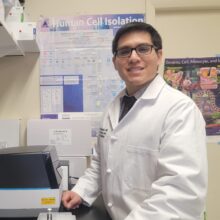
By Julio Huapaya, MD
As a pulmonologist who takes care of patients with myositis, one of the most difficult challenges I face when discussing their illness, is how unpredictable their lung disease can be. I often meet patients who share a similar diagnosis or even the same antibody, yet their lung disease behaves very differently. Some remain stable for years, while others experience progression despite treatment. That uncertainty is frustrating for patients, families, and clinicians alike, and it is what motivated this project.
In myositis, antibody tests are an important part of diagnosis. But in routine clinical care, these tests are usually reported as simply positive or negative. Over time, I began to wonder whether we were missing important information by not looking more closely at these antibodies.
With the support of The Myositis Association, my goal was to explore whether measuring how much antibody is present in the blood, rather than its presence alone, could help us better understand lung disease in myositis. I also wanted to see whether patterns in other blood proteins might give us clues as to why lung disease is more severe in some patients than in others.
Instead of asking simply, “Is the antibody there?”, we asked a different question: “How much of the antibody is there, and does it change over time?” We combined this with detailed protein measurements from blood samples, looking for biological patterns that might reflect different disease processes. This work started as a focused, exploratory project, but as we began to see how much variability existed between patients, it became clear that expanding the number of patients studied was essential to really understand these patterns.
One of the first things we found was that antibody levels vary widely, even among patients with the same antibody. For some antibodies, higher levels appear to be linked to changes in lung function, especially measures related to oxygen transfer. For others, the relationship seems different. This reinforces the idea that myositis is not a single disease, but a group of related conditions that behave differently depending on the underlying biology.
We also examined proteins in the blood that reflect inflammation, immune activity, and tissue stress. When we looked at these proteins together, certain patterns emerged that seemed to group patients into biologically similar categories. One of these patterns was associated with more lung injury and worse outcomes, suggesting that blood-based markers may eventually help identify patients who need closer monitoring.
It’s important to emphasize that this work is still evolving. We are continuing to refine the laboratory methods, increase the number of patients studied, and carefully account for factors such as medications and how long someone has had the disease. These steps are critical to making sure the results are reliable and meaningful.
For people living with myositis, the long-term goal of this research is better, more individualized care. If we can better understand what is happening biologically in each patient, we may eventually be able to monitor disease more closely, recognize changes earlier, and tailor treatment decisions more thoughtfully.
This project has also helped support the growth of a clinical and research program focused on autoimmune lung disease, allowing us to learn directly from patients and bring their experiences back to relevant research questions.
This work would not have been possible without the support of many people and institutions. I am deeply grateful to The Myositis Association and, most importantly, to the patients and families who generously volunteer to participate in research. I am especially thankful for the mentorship and guidance of Drs. Anthony Suffredini, Sonye Danoff, and Peter Burbelo, whose complementary expertise in myositis-associated lung disease, translational research, and assay development are foundational to this project. I am also grateful to the Johns Hopkins Myositis Center, as well as multiple institutes within the NIH (NIAMS, NIEHS, and NIDCR), for fostering a collaborative clinical and research environment that supported this work.
Dr. Huapaya is a lung specialist who recently completed a research fellowship at the NIH with support from TMA’s Research Grants Program.


Dr. Huapaya, thank you for this article. I have had dermatomyositis for 20 years. At the beginning I had numerous blood clots in lungs and real difficulty with my breathing on and off through the years. Unfortunately, because I am an obese female – all doctors look at me and decide any issue I have is due to weight. I don’t believe, despite my breathing issues at times or the fact that I have been told I can’t afford for lungs to get worse – I don’t believe anyone (not my rheumatologist, not past pulmonologists) have ever tested to even check for antibodies. I live in a small town in New York. While my doctors are affiliated with a large teaching hospital, I wish they would look at this research.