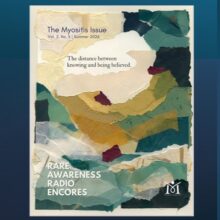
The Myositis Association and Community Resonance Foundation Publish Myositis Issue of ENCORES
Belfast, ME – August 2026 – What happens when a disease is difficult to recognize, difficult to diagnose, and often difficult to explain to people who have never encountered it?
The answers can look very different depending on where you stand. A person living with myositis may be trying to adapt to a changing body. A family member may turn loss into advocacy. A clinician may confront the limits of what the healthcare system can provide. A researcher may ask what it will take to reach people who have been left out.
The Myositis Issue of ENCORES, a publication of Community Resonance Foundation, brings these perspectives together through seven narrative accounts of diagnosis, care, advocacy, representation, research, and community building.
Laurie Boyer reflects on the loss of her brother Tommy and the years of advocacy that followed, including her leadership with TMA and efforts to strengthen the infrastructure supporting the myositis community.
Ed and Marilyn McGrath describe decades of living with dermatomyositis and the role community support has played in helping them navigate the disease and support others.
Holly Jones, who was diagnosed with polymyositis and interstitial lung disease at 19 and told she would not live to 24, shares her two-decade effort to build the community she was told did not exist.
Vance Robinson, who lives with inclusion body myositis (IBM), describes the realities of daily life while building awareness through the First Pitch Campaign, an initiative he started to bring myositis awareness to baseball fields across the country.
Jen Swisher, a physician assistant (PA) who works in emergency medicine and teaches at Chapman University’s PA program, recounts her diagnostic journey and the lessons she is passing on to the next generation of PAs.
Dr. Iazsmin Bauer Ventura, Director of the University of Chicago Myositis Program, explains why progress in myositis is not only about new therapies, but also about building places where expertise is shared, patients are trusted, and research reaches those who have long been left out.
Dr. Namita Goyal, Director of Neuromuscular Medicine at the University of California, Irvine and chair of TMA’s Medical Advisory Board from 2024 to 2025, describes how she pursued specialized training in muscle biopsy when delays in diagnosis were limiting care for her patients.
Across these seven conversations, several themes emerge: the continuing work of making illness understandable and recognizable, the informal workarounds people develop when systems do not provide a clear path, the influence of geography and demographic identity on disease experiences, the gap between information and usable knowledge, and the often-unrecognized work involved in living with serious illness.
“These voices carry knowledge that is difficult to generate outside the community,” said Scott Milligan, PhD, Executive Director of Community Resonance Foundation. “Most importantly, they offer hope. For someone facing a difficult and uncertain disease experience, knowing that there is a community ready to help, share what it has learned, and walk alongside them can change what comes next.”
“The people living with myositis and those who care for them have always been central to the work of The Myositis Association,” said Paula Eichenbrenner, MBA, CAE, Executive Director. “These stories show the range of experiences within our community and the importance of making those experiences visible to one another, to healthcare professionals, and to researchers. We are pleased to partner with Community Resonance Foundation to share these perspectives more broadly.”
Read The Myositis Issue online or download as a pdf.
About The Myositis Association
The Myositis Association (TMA) is the leading international nonprofit organization committed to support and education for myositis patients and care partners, increasing awareness of myositis throughout the community and among physicians, and funding for myositis-related research. Learn more at myositis.org.
About Community Resonance Foundation
CRF is a 501(c)(3) nonprofit working at the intersection of community engagement, qualitative research, and knowledge translation. CRF helps advocacy organizations capture lived experience narratives, publish community-centered materials, and translate those perspectives into actionable evidence and communications that inform clinical, research, policy, funding, and life sciences audiences. Learn more at resonancefound.org.


