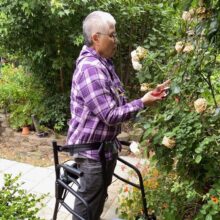
One of the uncertainties Lori Wong faced when she was diagnosed with inclusion body myositis (IBM) was whether she would be able to keep gardening. “I’ve been gardening forever,” she says. “I love it.” Lori lives in Riverbank, in California’s Central Valley, where there are gardening chores to be done almost every month of the year.
Pursuing her hobbies wasn’t the first thing on her mind, though, when she was seeking a diagnosis. Back in 2015, as she struggled to understand the reason for her unexplained loss of strength and several falls, her journey from doctor to doctor will be familiar to anyone with myositis. One doctor suggested IBM, and six years later another confirmed it.
After a year of rapidly declining muscle strength—and worrying about her ability to do things on her own—Lori’s neurologist suggested infusions of IVIG, which she continues to this day. That allowed her physical therapy exercises to help her recover some lost muscle strength and regain some independence. A side benefit was that episodes of choking while drinking water subsided as well.
At every step of her journey, Lori took time to meet the emotional aspects of her disease and consider how to find meaning and joy within her new limits. Retired after a career in physics and computer programming, Lori embraced an avocation dedicated to mindfulness—studying, practicing, and teaching it—and training people to cultivate kindness and compassion.

“I practiced compassion for myself,” she says, noting that we can be judgmental about ourselves in relation to our health. “It’s an essential tool for coping with IBM.”
Her long-time practice helped her make space, grieve, and acknowledge the emotional pain of continuing loss that this disease entails without getting stuck in it. She also understood that being outside was nourishing and helpful for her well-being, she says. “There’s nothing quite like being in green places and touching the soil.”
Lori is not alone in her understanding of the long-established scientific evidence of the importance of nature in healing. Therapeutic gardens have been used in hospitals for thousands of years and were strongly supported by Florence Nightingale, widely considered the founder of modern nursing. In England, some spine-injury clinics are surrounded by gardens with raised beds and wheelchair-friendly paths. In Japan, researchers found that even simply looking out a window at a garden gave long-term patients a boost. In a survey by Thrive, a British garden-advocacy nonprofit, one-quarter of respondents with disabilities listed gardening as an activity they could still enjoy. In northern Europe, Green Care farms proved so popular that there are now hundreds of such facilities in Norway and the Netherlands.

In the past, Lori—with help from her husband—planted fruit trees and ornamental perennials, built raised beds, and planted vegetables, pruned, and weeded the garden. When she could no longer stand up from squatting or bending over due to IBM, the answer was elevated pots and raised beds that made it easier to reach the plants.
It is early winter—foggy and cool—at the Wong household in Stanislaus County, and Lori works when she can at pruning the shorter plants within reach. Other plantings in her garden include persimmon, orange, grapefruit, fig, and loquat trees.
After researching tools, she found that a long-handled pruner was the best option for her. Many were heavy, but she located a lightweight, telescoping model that worked well––a long reach bypass pruner, which can be found in versions that extend from 3 to 7 feet. She also is able to water with a long-handled watering wand.
Lori relies on a mobility tool that gives her more stability than an ordinary walker. A specialized, hands-free walker that secures the user with a hip belt keeps her safe from falls when she is using both hands to prune or when she is working in the kitchen.
In addition to the mental and emotional boost she gets from being in the garden, she finds that the active engagement of her arms and legs gives her functional exercise while doing something she loves.
“It’s not the kind of gardening I did before my illness,” she says, “but it still brings me joy to be active in the garden.”


