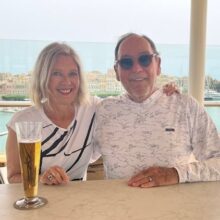
Cindy and Bill Ebert waited a while for Bill to get an accurate diagnosis, but that will come as no surprise to others with IBM. Neither will the Jacksonville couple’s path before seeking medical help.
“I think he showed symptoms at least six years ago,” Cindy says. “He was slowly getting weaker, but for a while we thought it was normal aging.” Then, the retired architect began falling so much it didn’t seem normal. The first neurologist they saw suggested it was peripheral neuropathy, a common ailment of aging with no effective treatment.
“A second neurologist confirmed the opinion of the first,” Cindy recalls. Unsatisfied, the couple pressed on. A third neurologist suspected IBM and ordered blood tests and conducted EMG and nerve conduction studies to determine a diagnosis of IBM. That neurologist found the signs to be so clear that he didn’t see any need to do a biopsy. Bill’s weakened quads and fingers, his trouble walking and balancing, his backward falls: they all led to the diagnosis. The IBM diagnosis was confirmed by a fourth neurologist.
“We were floored,” Cindy says. They’d never heard of the disease, never suspected a whole constellation of problems could have one name. They searched the internet and became more fearful as they could find no evidence of a cure, or even an effective treatment. Somewhere in their search, they found TMA and discovered that MyoCon was to be held that September.
“It was already April,” Cindy says, “but we immediately registered.” Once there, it was an eye-opener, she says. They met people who had had similar experiences and were now traveling the same path, with the same challenges. They saw how people coped, what strategies and equipment helped them. Bill now has a rollator and a cane, and Cindy knows what circumstances––like negotiating a curb––are especially dangerous.
They also learned that certain exercises could help. “We had been afraid of exercise because of the falls,” Cindy says. “In fact, one time when I was behind Bill, trying to steady him, we both went down when he fell backwards.”
What changed their minds? It was a happy coincidence, Cindy recalls. “We were walking by an exercise session at MyoCon, and Joe Sanchez pulled us in. We told him we couldn’t take this session and he says, ‘Yes, you can. Trust me.’” Sanchez, known in the myositis community as “Myositis Joe,” has been a staunch believer in appropriate exercise for myositis for well over a decade.
Now, Bill exercises, following an online program tailored for people with IBM. Cindy also exercises diligently three times a week. “I have to be in good shape to help Bill,” she says. She sometimes finds it hard to come to a balance between helping him and allowing him some independence. “I have to remind myself not to hover.”
Their day-to-day life has limitations, but they fill it with as much normalcy as they can. “Bill still drives,” she says, “and we’re able to go out and see friends. A recent neurologist visit showed he’d lost some strength, but the loss is very slow.” One of the hardest things for her has been trying to explain the symptoms to children and grandchildren. “He looks fine,” she says. “I have to tell them that he just can’t go to the kids’ soccer games. They’re beginning to understand.”
Still, there has been plenty of drama. Like other IBM care partners, Cindy has learned a lot about fall recovery. In some cases, she’s able to help Bill up, and in others she’s had to call on friends. One especially bad fall sent Bill to the emergency room with a brain bleed.
The trip to the Dallas MyoCon shortly after Bill’s diagnosis gave the couple a crash course in traveling with myositis. “I found the airlines very helpful in having wheelchairs available going to and from the plane,” Cindy says.
Although still learning herself, Cindy has some advice for other newly-diagnosed partners: “Get to a MyoCon as quickly as you can.” In talking to the people there, she learned about maintaining nutrition, and the importance of communication between partners. She learned that she needs to look ahead, and plan for the future. “Bill’s an architect,” she says. “Our house was built for aesthetics, not handicapped accessibility.” If she could wish for one thing, it would be for studies examining ways to slow the disease down. For now, though, she says, “We have everything we need.”
Registration for MyoCon 2026: TMA’s Global Myositis Patient Conference is now open. Early bird discounts are available.


