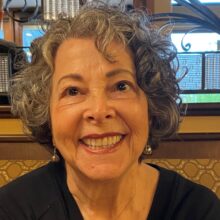
By Karen Perkul
“I’m getting older.” “I’ve always been rather clumsy.” “I need to pay better attention to where I’m walking.” Sound familiar?
I was walking three miles a day with my dog, working out with a personal trainer twice a week. So why was I struggling to get up off the floor? Why were stairs becoming so difficult? Why was I falling so frequently and not able to figure out what had caused it?
Thinking back to 2018 when I was diagnosed with inclusion body myositis, I recall first thinking that it was really hard to pronounce, followed quickly by a feeling of relief that I could make some sense of the physical struggles that I had recently begun to notice. Now that I had a diagnosis—an explanation—somehow everything would be easier. That’s what I thought.
A short time later I attended my first TMA conference where I was inspired by the many people who seemed to be doing so well. Yes, they may have been using canes, walkers, and wheelchairs, but they were cheerful and optimistic, eager to learn about clinical trials, the latest research, adaptive techniques and equipment. I promised myself that I would be like them: upbeat, intellectually curious, a myositis advocate, and as independent as possible.
I didn’t allow myself to experience self-pity. After all, so many people had it worse than me. The glass was always half full, never half empty. I take care of others; I don’t need help. I don’t want anyone to feel sorry for me. I don’t want to be a downer. I was going to be the perfect myositis patient. I participated in a clinical trial. I attended a myositis support group. I traveled to all the TMA annual conferences. I read the current research. I was always optimistic, never complaining, a true Pollyanna.
This attitude worked really well—until it didn’t. It didn’t allow me to pay attention to all the losses I had experienced: I used to love hiking, kayaking on the lake, getting down in the dirt to garden. This outlook didn’t make room for me to mourn the activities I had previously taken for granted or to truly acknowledge what additional losses are likely in my future.
This denial, what I now think of as my personal blindfold, was painfully removed when my husband and I started to plan a vacation. In the past, national parks had been our favorite. Anywhere we could hike, explore the countryside, be out in nature. Or maybe travel to a quaint location where we could walk cobblestone streets, climb winding steps, investigate old buildings. Each vacation discussion resulted in me feeling sad, frustrated, and confused. If couldn’t do these things any longer, what could I do and actually enjoy? My very perception of myself, my identity, seemed no longer to fit.
With the help of a great therapist—I didn’t want to unload on family or friends—I gave myself permission to feel sad, to feel angry, to begin mourning for what I could no longer do. Although I struggled with asking for help—I was always the helper, not the helpee—I learned to accept that I could be both. I could be sad about the loss of what I can no longer do AND enjoy to the maximum what I currently am able to do.
As I grieved the past and gradually accepted my current new normal, I was better able to move forward to explore new ways of satisfying my needs. Now I spend more time painting with pastels, recognizing that at some not-too-distant date I may no longer be able to do so. I garden using elevated planters. I take long “walks” in a wheelchair with help from others. I work hard to focus on the present, absorbing all the pleasure in each of these activities. I have found that my relationships with friends and family have become stronger. I continue to volunteer: driving friends to doctors’ appointments, serving on committees, making phone calls.
Today, I believe that the most important truth I have learned in my IBM journey is that life is not so much about either–or, but rather and. I can be sad about past, current, and future losses AND be grateful for all that I currently can do. I can feel frustrated when struggling to do today what I could do much more easily yesterday AND investigate ways to adapt to get these things done. I can help others AND ask for help when I need it. I’m not suggesting that this is easy or that I’m always able to keep these thoughts front and center. I can only do my best AND give myself permission to throw up my hands in despair.
Any time we do something new, there’s a learning curve. So let’s give ourselves permission to struggle, learn, and grow as we deal with this disease. After all, we’ve never had IBM before!
Karen Perkul is a wife, mother, and grandmother. Now retired, she worked as a first-grade teacher, clinical social worker, and bookkeeper. She has always embraced learning and change, tendencies that IBM is providing plenty of opportunities to practice.


